
To download the bookmark, right-click the image and select “Save Image”.
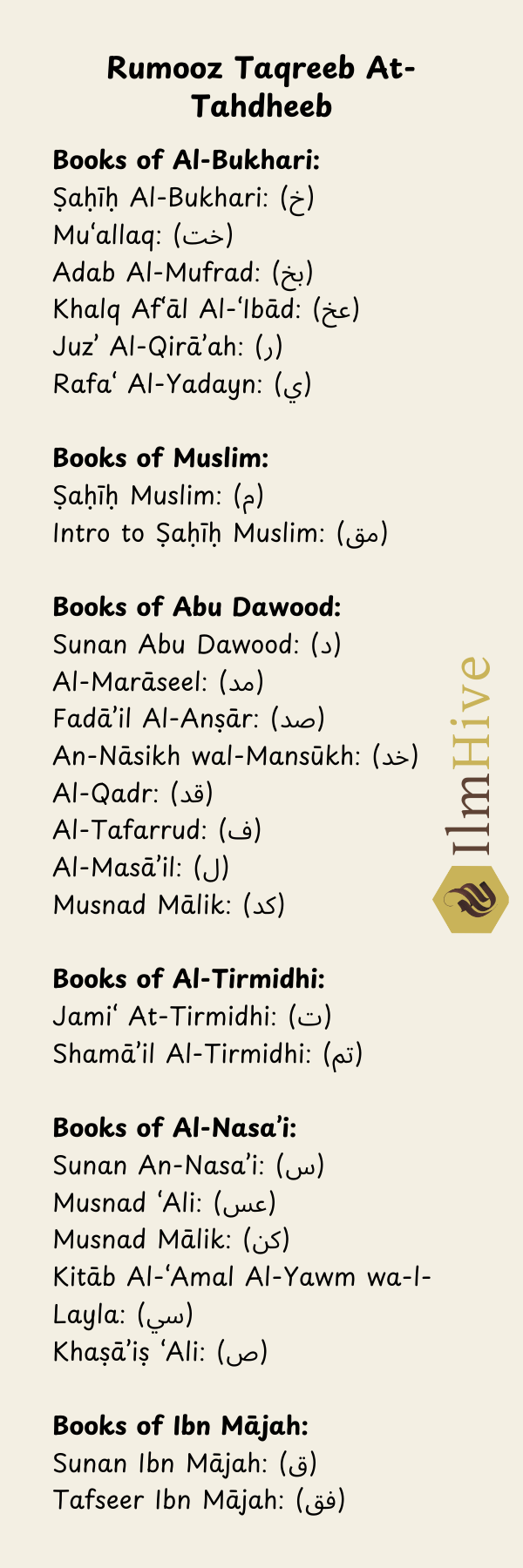
The Symbols and Their Meaning in Taqreeb At-Tahdheeb by Ḥāfiẓ Ibn Ḥajar al-Asqalani
In his monumental work Taqreeb At-Tahdheeb, Ḥāfiẓ Ibn Ḥajar introduces a system of symbols to indicate which major hadith scholars and collections have narrated the reports of specific narrators. This system is a crucial tool for scholars and students of hadith to quickly identify the sources where a narrator’s hadiths can be found, particularly within the six major hadith collections (Sihah Sitta) and related works.
Explanation by Ḥāfiẓ Ibn Ḥajar
Ibn Ḥajar states:
وقد اكتفيت بالرقم على أول اسم كل راوٍ، إشارة إلى من أخرج حديثه من الأئمة.
“I have used numbers at the beginning of each narrator’s name to indicate which of the imams have recorded their hadiths.” (تقريب التهذيب – ص: 76)
Symbols for the Six Major Collections and Related Works
Ibn Hajar further clarifies his methodology by listing the symbols and the corresponding references as follows:
Books of Al-Bukhari:
- Ṣaḥīḥ Al-Bukhari: (خ)
- Mu‘allaq (Disconnected Narrations): (خت)
- Adab Al-Mufrad: (بخ)
- Khalq Af‘āl Al-‘Ibād: (عخ)
- Juz’ Al-Qirā’ah: (ر)
- Rafa‘ Al-Yadayn: (ي)
Books of Muslim:
- Ṣaḥīḥ Muslim: (م)
- Introduction to Ṣaḥīḥ Muslim: (مق)
Books of Abu Dawood:
- Sunan Abu Dawood: (د)
- Al-Marāseel: (مد)
- Fadā’il Al-Anṣār: (صد)
- An-Nāsikh wal-Mansūkh: (خد)
- Al-Qadr: (قد)
- Al-Tafarrud: (ف)
- Al-Masā’il: (ل)
- Musnad Mālik: (كد)
Books of Al-Tirmidhi:
- Jami‘ At-Tirmidhi: (ت)
- Shamā’il Al-Tirmidhi: (تم)
Books of Al-Nasa’i:
- Sunan An-Nasa’i: (س)
- Musnad ‘Ali: (عس)
- Musnad Mālik: (كن)
- Kitāb Al-‘Amal Al-Yawm wa-l-Layla: (سي)
- Khaṣā’iṣ ‘Ali: (ص)
Books of Ibn Mājah:
- Sunan Ibn Mājah: (ق)
- Tafseer Ibn Mājah: (فق)
Key Rules for Applying Symbols
1. Primary Sources:
If a narrator’s hadith appears in any of the six major collections (Sihah Sitta), the corresponding symbol is used. Even if the same hadith is found in other works, no additional symbols are added.
2. Comprehensive Reference:
If the narrations of a narrator are present in all six collections, Ibn Ḥajar uses the symbol (ع).
3. Excluding the Two Sheikhs:
For narrators whose hadiths are present in the works of the four imams (Abu Dawood, Al-Tirmidhi, Al-Nasa’i, and Ibn Mājah) but not in Ṣaḥīḥ Al-Bukhari or Ṣaḥīḥ Muslim, the symbol (4) is used.
4. Narrators Outside These Works:
If a narrator’s hadith is not found in the six collections or their associated works, Ibn Ḥajar assigns the term (تمييز), indicating that the narrator is included for distinction rather than for their contributions to these major collections.
5. Unmarked Narrators:
If no specific symbol is assigned to a narrator, Ibn Ḥajar either mentions their status explicitly or includes them in an appendix with additional commentary.
