حَدَّثَنَا الْحُمَيْدِيُّ عَبْدُ اللَّهِ بْنُ الزُّبَيْرِ، قَالَ حَدَّثَنَا سُفْيَانُ، قَالَ حَدَّثَنَا يَحْيَى بْنُ سَعِيدٍ الأَنْصَارِيُّ، قَالَ أَخْبَرَنِي مُحَمَّدُ بْنُ إِبْرَاهِيمَ التَّيْمِيُّ، أَنَّهُ سَمِعَ عَلْقَمَةَ بْنَ وَقَّاصٍ اللَّيْثِيَّ، يَقُولُ سَمِعْتُ عُمَرَ بْنَ الْخَطَّابِ ـ رضى الله عنه ـ عَلَى الْمِنْبَرِ قَالَ سَمِعْتُ رَسُولَ اللَّهِ صلى الله عليهوسلم يَقُولُ “ إِنَّمَا الأَعْمَالُ بِالنِّيَّاتِ، وَإِنَّمَا لِكُلِّ امْرِئٍ مَا نَوَى، فَمَنْ كَانَتْ هِجْرَتُهُ إِلَى دُنْيَا يُصِيبُهَا أَوْ إِلَى امْرَأَةٍ يَنْكِحُهَا فَهِجْرَتُهُ إِلَى مَاهَاجَرَ إِلَيْهِ ”.
Narrated ‘Umar bin Al-Khattab:
I heard Allah’s Messenger (ﷺ) saying, “The reward of deeds depends upon the intentions and every person will get the reward according to what he has intended. So whoever emigrated for worldly benefits or for a woman to marry, his emigration was for what he emigrated for.”
Sahih al-Bukhari Hadith 1
Abdullah ibn Masud relates that a man emigrated to marry a woman called Umm Qays, so the man was known as muhajir Umm Qays (the one who emigrated for Umm Qays).
Some have argued that ال in the word الاعمال has come for istighraaq (encompassing all) i.e. that every action is judged upon its intention. For example if one went a whole day without eating, but his purpose was not to fast then they will not be rewarded for this action. On the other hand if they made the intention to fast and then did not eat the whole day then they will be rewarded.
Narrators
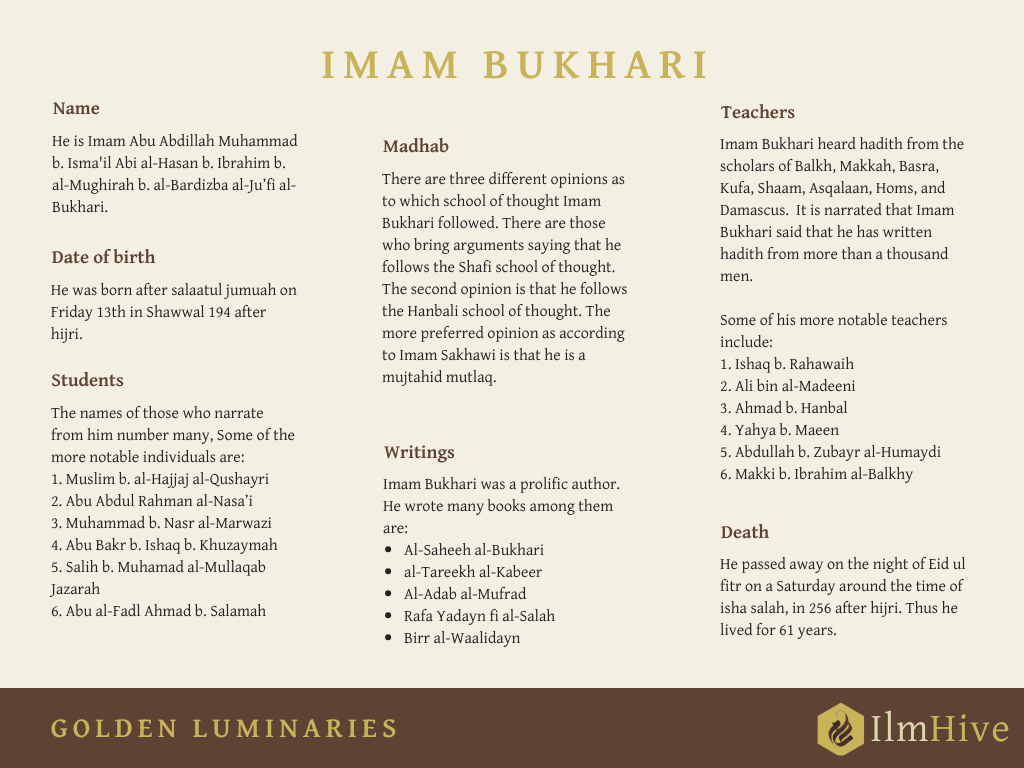
Humaidi – His name is Abdullah bin Zubayr al-Humaydi died 219H. He is also known as Makki. It has been said that Imam Bukhari started his book with the narration of Humaidi due to his link to Makkah, as this was where wahy began[1].
Sufyan – His name is Sufyan bin Uyaynah al-Makki al-Tabiee (d. 198H[2]). He completed Hajj seventy times[3]. It is mentioned that he heard from seventy tabieen[4]
Yahya bin Saeed al-Ansary (d. 143H[5]) was from the sighaar tabieen. His grandfather was Qays bin Amr who was a Sahaba. His teacher was Muhammad bin Ibrahim al-Taymiy (d.120H[6]) who was from the awsat tabieen. His teacher Alqamah bin Waqqas al-Laythi was from the kibar tabieen[7].
The relation between hadith al-niyyah and the chapter of wahy
Ibn Hajar mentions that this hadith is only brought for blessings. Imam Bukhari brought this hadith to remind himself (or others) about the importance of having good intentions before starting an act. Abdul Rahman b. Mahdi iterates the importance of having good sincere intentions and says that this hadith should be brought at the beginning of every chapter.
It has also been mentioned that this hadith fulfils the purpose of having a khutba for the kitab, as it comes in the hadith that Umar (ra) was giving khutbah in the presence of sahaba, and therefore Imam Bukhari lets this suffice as the khutbah for his book. However if this was the case then Imam Bukhari should have brought this before the tarjamah(chapter heading) as others have done.
Ibn Muneer says that during the beginning of prophethood, the Prophet ﷺ would travel to the cave of hira, for the sake of Allah. Therefore this hadith is linked as it talks about emigration for the sake of Allah.
Allamah Saharanpuri says that one of the reasons Imam Bukhari brought this hadith first is because it was the first hadith which the Prophet ﷺ narrated when he arrived at Madina[8].
Another reason why this hadith may have been brought first is that it is related to the word بدء meaning beginning. All beginnings should be made with ikhlas (sincerity). Since Imam Bukhari is talking about the start of wahy, and also starting his book he started with this hadith.
[1] Al-fath al-Bari vol.1 p.17
[2] Hashiyah Saharanpuri vol.1 p.119
[3] Al-kawthar al-Jari p.30
[4] Al-fath al-Bari vol.1 p.17
[5] Hashiyah Saharanpuri vol.1 p.119
[6] Hashiyah Saharanpuri vol.1 p.119
[7] Al-fath al-Bari vol.1 p.18
[8] Hashiyah Saharanpuri vol.1 p.119