
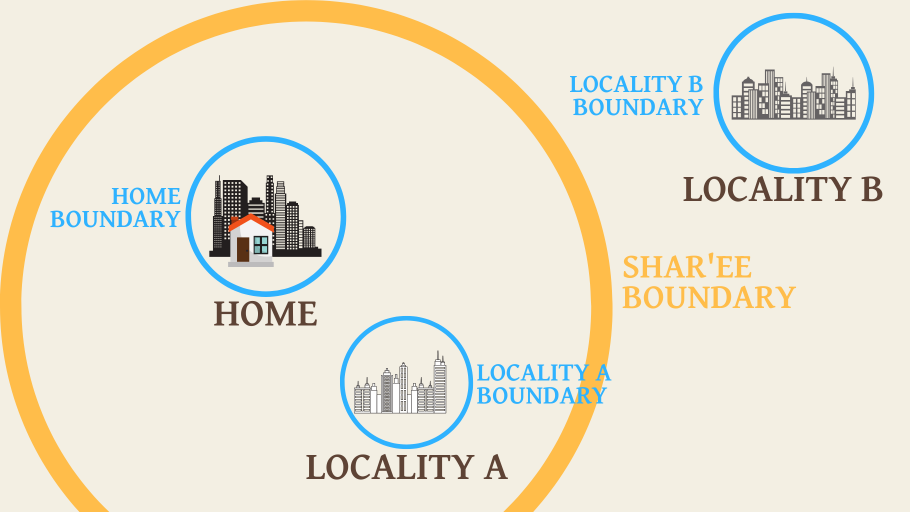
Explanation of Diagram
The orange circle represents the shar’ee distance for which a person must travel in order to be considered a musafir.
The blue circles represent the boundaries of their respective localities. If a person stays overnight within this boundary they will be considered to have stayed within that locality.
Locality A is considered to be a different locality to that of the home locality, hence it has its own border. However it falls within the set shar’ee distance from the home locality.
Locality B falls outside of the shar’ee distance, hence if one travels from home to Locality B they will be considered a musafir (provided they have met all conditions).
Note: In some cases the border of a city may extend to more than the shar’ee limit according to some opinions as in the case of large cities like Delhi.
When are you considered a Musafir?
Shar’ee distance does not consider time taken
In order for a person to be considered a m
It is important to note that distance is the important factor and not time, such that even if one arrives at the destination in a shorter period of time, they will be still be considered to be a musafir (provided all conditions are met).
Scenario
If a person travels from their home to locality B, they will be considered a musafir as soon as they have left the boundary of their home locality. This is because locality B is more than the stipulated shar’ee distance from the boundary of their home locality. The person will be considered a musafir irrespective of whether they arrive at the destination within a matter of minutes, hours or days e.g. by train or plane.
A destination must be specified
In order for a person to be considered a Musafir they must intend to travel to a specific destination, such that its distance is more than the shar’ee distance (al-Jawharah al-Nayyirah).
Scenario
A person travels around from place to place, never intending to travel to a specific destination. The person ends up travelling more than the shar’ee distance and like this travels around the whole world. In this case the person will not be considered a musafir. This is because a destination of more than the stipulated shar’ee distance was not specified.
The destination is not uninhabitable
In order for a person to be considered a muqeem they must intend to stay at a destination which is usually for residing like a city or village. A person cannot be considered muqeem in an uninhabitable place. (Badaai al-Sanaai)
Scenario
A person intends to travel to a desert, island or a boat and stay there for 15 nights or more. He will not become a muqeem, and will be considered a musafir for the full duration of his stay. This is because these places are not usually for residing.
Shar’ee distance is measured from the boundary
The shar’ee distance is measured from the boundary of the home locality and not the home itself, up to the boundary of the destinations locality, and not the destination itself. This means that Google maps may not be the best option to measure distances between two places in cases where the distances are very close to the shar’ee distance. This is because Google maps measures door to door, or from ones door to the centre of a city.
Scenario
A person travels from their home to locality A. Locality A is such that if measured from the home it measures more than the shar’ee distance, however if measured from the boundary of the home locality it falls within the shar’ee distance. Then in this case, the person will not be considered a musafir.
Shar’ee distance is not measured as the crow flies
The shar’ee distance is calculated as the distance travelled on route, and not the direct distance between two destinations (as the crow flies).
Scenario
A person travels from their home locality to locality C. The distance between the borders of both localities is less than the shar’ee distance. However the shortest path from the borders of both localities is more than the shar’ee distance. In this case, the person travelling from their home to locality C will be considered a musafir. This is because the least possible distance which needs to be travelled is more than the stipulated shar’ee distance. This is in spite of the fact that the distance measured as the crow flies is less than the shar’ee distance.
Shar’ee distance is measured as the route taken
The shar’ee distance between two destinations is measured as the route taken to the destination.
Scenario
A person travels from their home locality to locality A. Locality A falls within the stipulated shar’ee distance. The person takes a different longer path to get to their destination. Therefore the person travels more than the shar’ee distance. In this case the person will be a musafir, as the route taken exceeded the shar’ee distance.
Intention must be combined with the action of travelling
Intention to travel does not make one a musafir. The intention must be combined with the action of travel. Likewise as mentioned previously, travelling more than the shar’ee distance does not make one musafir if there is no intent to travel more than the shar’ee distance.
Scenario
A person travel from their home locality to locality B, however they did not have the intention of travelling there. In this case they will not be considered a musafir.
Intention to stay should be less than 15 nights
In order for the rulings of a musafir to apply, one must intend to stay at their destination for less than 15 nights.
Scenario
A person travels from their home locality to locality B with the intention of staying for 14 nights or less. In this case they will be considered a musafir.
Scenario
A person travels from their home locality to locality B with the intention of staying for 15 nights or more. In this case as soon as they enter the boundary of locality B they will be considered a muqeem.
Intention is key, not action
As long as one intends to stay less than 15 nights, they will be considered a musafir. This is even if they end up staying longer. This is similar to the examples of Ibn Umar who stayed in Azerbaijan for 6 months, and Anas (ra) who stayed in Nisapur for a year, both doing qasr.
Scenario
A person travels to locality B with the intention of staying less than 15 days. However due to some matter they are delayed in their return and stay longer than 15 days. Likewise they stay at this place for a year, never intending to stay longer than 15 days. In all this time they will be considered a musafir.
Example
A person travelled from London to Bangladesh, with an open ticket, intending to stay for less than 15 nights. They are waiting for the recovery of a relative. Doctors say that the recovery should take place within a matter of a few days. However 15 days elapses, and again the doctors say it should be complete within a matter of a few days. Likewise a few months pass. In all this time this person is considered a musafir.
Note: In the example above it is important that the person has an open ticket, as having a return ticket which is scheduled for more than 15 nights, indicates an intention to stay for longer than 15 nights. If the return ticket is within 15 nights the person will be considered musafir. If one has booked a return ticket, so long as the return is scheduled within 15 nights they will remain a musafir.
The intention of one being followed is considered
If a person is following another, then the intention of the one being followed will be taken to account (al-Jawharah al-Nayyirah).
For example if a slave is travelling with his master, the intention of the master will be taken to account. If a wife is travelling with her husband, the intention of the husband will be taken to acount. If an army is travelling with their leader, then the intention of their leader will be taken to account.
Rulings of a musafir apply from the boundary of the home locality
A person will be considered a musafir as soon as they have left the boundary of their home locality. Likewise they will be considered a muqeem as soon as they have entered the boundary of their home locality. This is regardless of whether they enter the home boundary for a need or in passing enroute to another destination.
Scenario
A person intends to travel to locality B, and from there will travel to locality A. They will stay in locality B for less than 15 nights, and again in locality A for less than 15 nights. In all this time they will be considered a musafir. This is even though locality A is within the shar’ee distance from home. Furthermore it does not matter if the total of both stays exceeds 15 nights. as long as one does not intend to stay at a place for more than 15 nights they will still be considered a musafir.
Scenario
A person intends to travel to locality B. They will be staying at locality A on route to locality B. As long as they stay less than 15 nights in locality A they will be considered a musafir. This is the case even though locality A is within the shar’ee distance. (Badaai al-Sanaai, page 499)
Scenario
A person intends to travel to locality B, from there they will travel back in the opposite direction to a locality C. If the person enters their home locality enroute to locality C, they will be considered muqeem as soon as they enter their home locality. This is irrespective of whether they go home or do not stay the night there.


