There are many different hadith genres[1]. Some of the more commonly known genres are listed below.
Saheeh (pl. Sihāh)
A saheeh is a compilation of hadith which is authentic as per the conditions of the author. Therefore, the criterion for saheeh in one book often does not match the criterion for saheehin another.
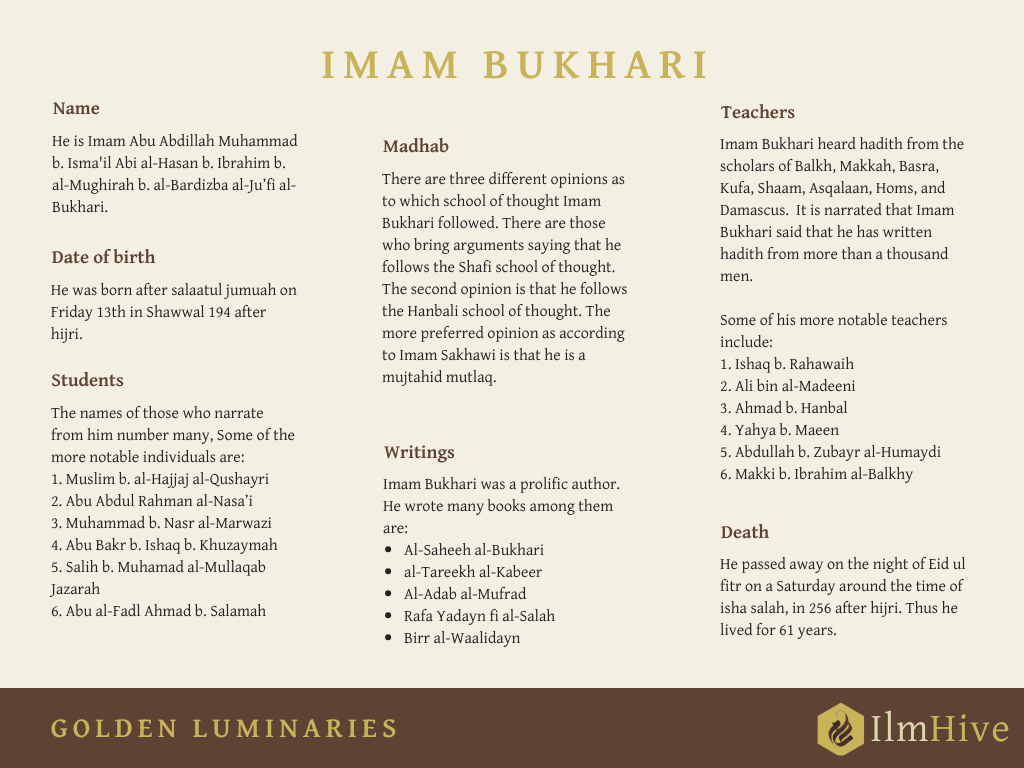
The two most famous works classed as saheeh are the Saheeh of Imam Bukhari, and the Saheeh of Imam Muslim. There are also others such as Saheeh Ibn Hibban and Saheeh Ibn Khuzaymah.
Jāmi` (pl. Jawāmi`)
A jaami is a collection of hadith which contains narrations on all of the following eight uloom;
- عقائد (Aqaaid) – Beliefs
- أحكام (Ahkam) – Rulings
- رقائق (Raqaa’iq) – Spirituality
- فتن (Fitan) – Tribulations of the Day of Judgement
- شمائل (Shama’il) – Character Traits
- آداب (Adaab) – Manners
- مناقب (Manaaqib) – Greatness of the Sahabah and the Prophet ﷺ
- ﷺتفسير (Tafseer) – Exegesis
This can be summarised in the phrase عارف شامت.
Some of the more famously known collections which also classify as a jaami include Saheeh Bukhari and Sunan Tirmidhi. There is ikhtilaad whether Saheeh Muslim is considered a Jami’, due to having only a few narrations in Tafseer.
Sunan (sing. Sunnah)
A sunan is a collection of hadith with a key focus on fiqh (Islamic jurisprudence). The narrations usually follow a specific order, and often start with chapters on purification and Salah.
Four of the six canonical works of hadith (sihah sitta) can be classified as sunan; Abu Dawud, Ibn Majah, Nasaai and Tirmidhi.
Musnad (pl. Masānīd)
A musnad is a collection of ahadith which has been arranged according to its primary narrator. This may be ordered in different ways such as alphabetical order, the order of their acceptance to Islam or the order of their seniority amongst the sahaba etc.
Musnad Ahmad Ibn Hanbal is one of the more famously known collections which can be classified as a musnad, but there are many others such as the Musnad of Abi Ya’la.
Mustakhraj (pl. Mustakharajāt)
A mustakhraj is a compilation of hadith which have similar wording (matn) but different chains of narration
For example, the Abu Nu’aym has two collections which can be classified as mustakhraj, one which includes additional narrations which meet the criterion of Imam Bukhari, and another which meets the criterion of Imam Muslim.
Musannaf (pl. Musannafāt)
A musannaf is a collection of hadith which contains ahadith as well as narrations of sahaba, and fatawa of tabieen[2]. It does not contain sayings of the author himself. The narrations are usually divided into chapters and includes both hadith mawquf (ascribed to companions) and hadith maqthu (ascribed to tabieen).
E.g. Musannaf Abdur Razzaque, Mussanaf Abi Bakr b. Abi Shaybah
Mustadrak
A mustadrak is a collection of hadith which uses the same criteria of another book of hadith.
For example, the Mustadrak of Hakim uses the same criterion used in Saheeh Bukhari and Saheeh Muslim.
Atraf
An
Juz
A juz is a collection of hadith narrated by one person, usually on one subject. This is regardless of whether they are sahaba or not.
For example, hadith of Abu Bakr, hadith narrated by Malik, Juz al Qira’at Khalf al Imam and Juz Raf’a al-yadayn both by Imam Bukhari,
Mu`jam (pl. Ma`ājim)
A mu’jam is a collection of ahadith written in alphabetical order according to the narrator.
One of the more well-known collections classified as mu’jam are al-Mu’jam as Saghir by Imam Tabarani, in which he has selected one hadith from each of his teachers.
Tajreed
A tajreed is a collection of ahadith where the chain of narration is omitted, therefore bringing only the matn of the hadith
e.g. Imam Tabreezi’s Mishkaat al-Masabeeh
[1]Such as muwatta, arbaeen, mawduaat, al-zawaaid, al-ilal, al-musalsalaat etc.
[2]A Muwatta can be considered the same as a musannaf even though the names differ