
Kitāb al-Ṭahāra: Wuḍūʾ
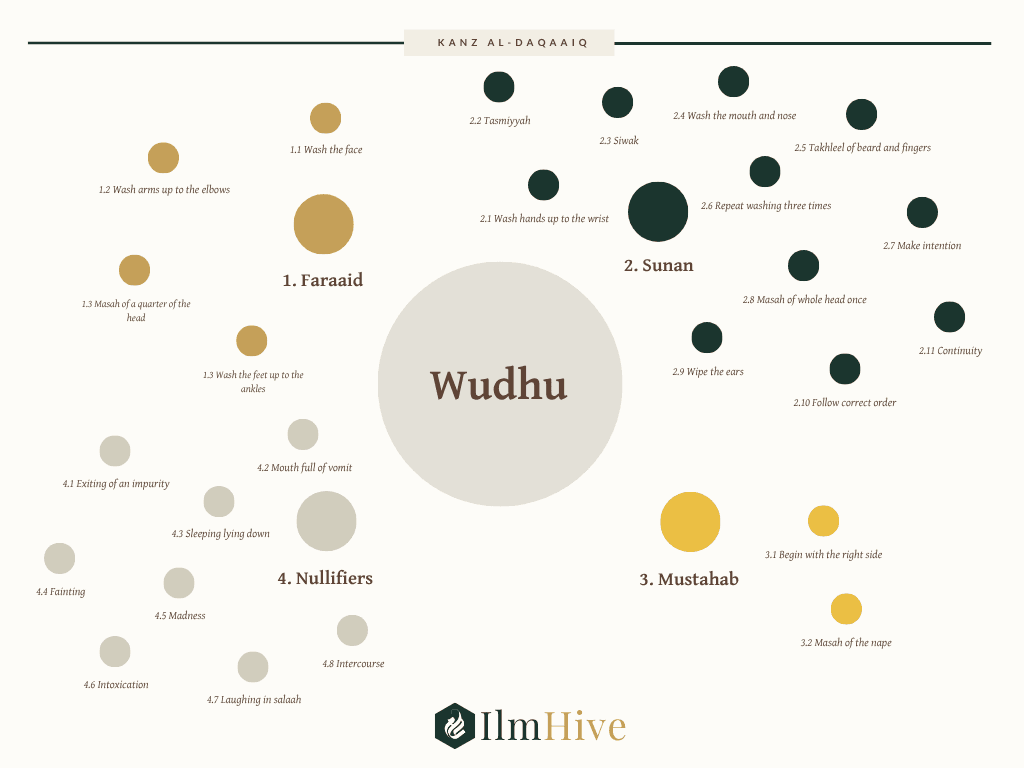 Overview diagram of the four obligations of wuḍūʾ: washing the face, washing the arms to the elbows, masḥ of the head, and washing the feet to the ankles
Farāʾiḍ of wuḍūʾ
Allāh ﷻ says in the Qurʾān:
The farāʾiḍ (obligatory acts) of wuḍūʾ are therefore four: to wash the face, to wash the arms to the elbows, to do masḥ of the head, and to wash the feet to the ankles.
The face means everything visible: from the hairline on the forehead to the chin, and from one ear to the other; all of this must be washed. Masḥ of at least a quarter of the head is farḍ.
Sunan of wuḍūʾ
A sunnah act is one that the Prophet ﷺ did regularly, while leaving it out occasionally.
The sunan of wuḍūʾ are: to wash the hands to the wrists at the beginning; to do tasmiyah, that is, to begin in the name of Allāh; to use the miswāk; to wash the mouth and nose; to do takhlīl of the beard and fingers; to repeat the washing of each limb three times; to make the intention to perform wuḍūʾ; to do masḥ of the whole head once; to wipe the ears; to follow the correct order; and to do the wuḍūʾ continuously without pause.
A few clarifications follow. On waking, before dipping his hand into the water vessel, a person should wash his hands three times. Takhlīl is to pass the spread fingers through the hairs of the beard and between the fingers. The ears are wiped with the residual water from the head, not with fresh water. The ulema differ over whether some of these are sunan or mustaḥabbāt; some count tasmiyah, siwāk, tartīb, continuity and intention as mustaḥabb.
Mustaḥabbāt of wuḍūʾ
A mustaḥabb act is one that the Prophet ﷺ did, but not regularly. Mustaḥabb has the same sense as mandūb, that is, a recommended act encouraged by the Prophet ﷺ even where he did not perform it after encouraging it.
- Beginning with the right side
- Masḥ of the nape
Nullifiers of wuḍūʾ
The following break wuḍūʾ: any impurity exiting the body; a mouthful of vomit; sleeping while lying down; fainting; madness; intoxication; laughing in ṣalāh; and intercourse.
A mouthful of vomit nullifies wuḍūʾ whether it is bile, coagulated blood, food or water. A mouthful of phlegm, or a mixture of saliva and blood in which the saliva predominates, does not. A worm that exits from a wound does not break wuḍūʾ. Touching one's own private parts does not break wuḍūʾ, and neither does touching a woman.