
Masḥ upon Bandages
Extract from Badāʾiʿ al-Ṣanāʾiʿ by ʿAllāmah al-Kāsānī and Tuḥfat al-Fuqahāʾ by ʿAllāmah ʿAlāʾ al-Dīn al-Samarqandī.
When masḥ over a bandage is permitted
If washing a broken, injured or wounded limb (or part of one) would cause harm, washing is not required: one performs masḥ over the bandage, cast or plaster instead.
The same applies if washing the injured part itself would cause no harm but removing the bandage would: masḥ over the bandage is then permitted.
If a bandage extends beyond the wound, covering parts of the limb that are not injured, the question turns on whether removing it would cause further harm. If removing the bandage is impractical, or if it cannot be replaced easily, or if removal would cause further harm, masḥ over the whole bandage is permitted.
If, however, the bandage can be removed and the uninjured area washed without further harm, masḥ over the bandage is not permitted: one must remove the bandage, wash the uninjured skin around the wound, and perform masḥ over the wound itself. If even masḥ on the wound would be harmful, one performs masḥ over the bandage and washes the surrounding area where possible.
This is the principle Ḥasan ibn Ziyād draws out: masḥ is permitted by reason of necessity, so the licence runs only as far as washing would cause harm, and no further.
The ruling of masḥ upon bandages
Is masḥ over a bandage strictly required, or may it be left out? Imām Abū Ḥanīfah holds that if masḥ on the bandage would cause further harm, it may be left out. Imām Abū Yūsuf and Imām Muḥammad hold that where masḥ would not cause harm, it cannot be left out: it must be performed.
On the soundest reading of Imām Abū Ḥanīfah's view, masḥ on the bandage is wājib when the limb cannot be washed, and is dropped only where it would cause harm. The basis is the ḥadīth1 in which the Prophet ﷺ commanded masḥ over the bandage; commands of the Prophet ﷺ, by default, indicate wujūb2 and are obligatory to act upon. Masḥ over the bandage is therefore required, save where it would cause harm; in that case, it falls away. The principle is parallel to the rule for washing: washing is not required where one fears harm, and likewise masḥ is not required where the same fear applies.
Whether masḥ may be performed over only part of the bandage is not addressed clearly in the early narrations. Ḥasan ibn Ziyād reports that masḥ over the majority of the bandage is permitted, but less than the majority is not.
What nullifies masḥ upon bandages
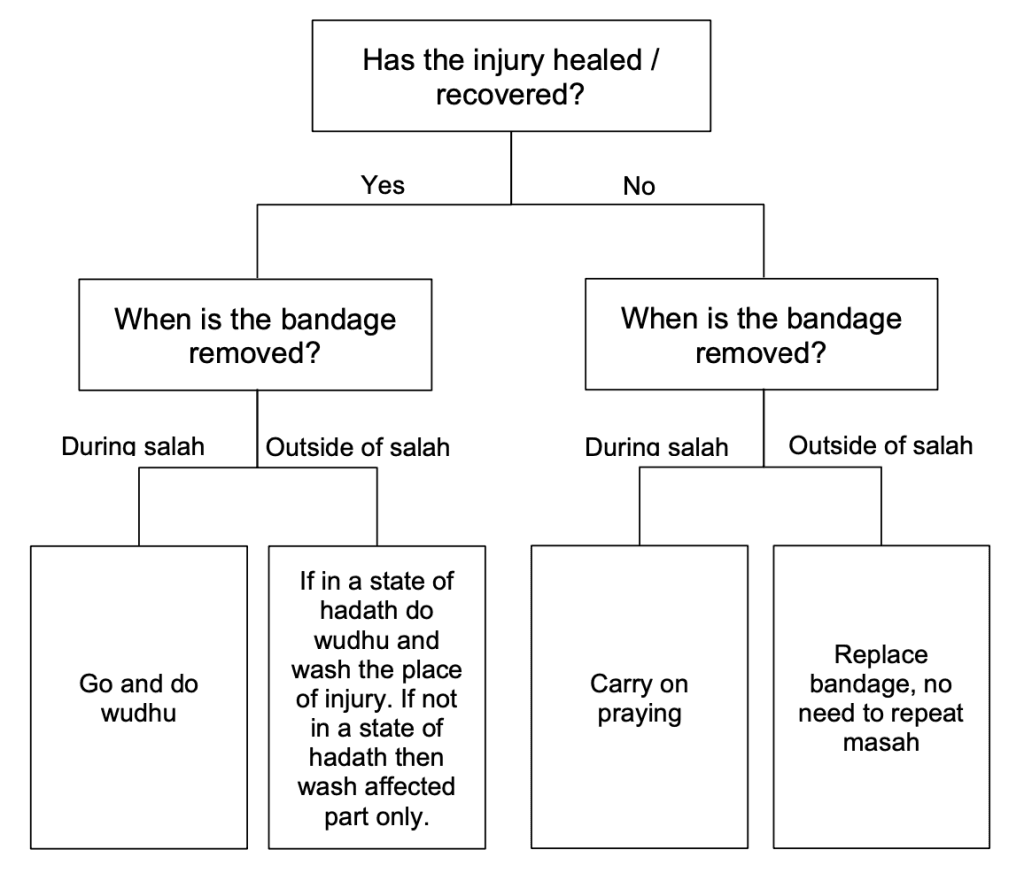
When the bandage is removed after masḥ has been performed, the injury is either healed or it is not, and the removal occurs either inside or outside ṣalāh. Each of the four resulting cases carries a different ruling.
If the bandage is removed before recovery: if the person is in ṣalāh he continues; if outside ṣalāh, he replaces the bandage and need not repeat the masḥ. Washing was excused on account of the injury, and the injury still stands. The wājib act was the masḥ itself, which has already been done. The case is parallel to the man who performs wuḍūʾ, does masḥ on his head, and then shaves his head: he need not repeat the masḥ.
If the bandage is removed because the injury has healed, and one is outside ṣalāh and not yet in the state of ḥadath after the earlier masḥ, the area previously covered by the bandage is now to be washed; nothing else need be repeated. Masḥ at this point is invalid, since washing is now possible.
If the bandage is removed during ṣalāh after recovery, one must leave and perform wuḍūʾ, since the original command (to wash the limb) is now possible to fulfil and is the means to the intended end (the prayer).
Below is a summary of the ruling when the bandage is removed:
The difference between masḥ on khuffayn and on bandages
First, masḥ over a bandage is not bound to a fixed period; it runs until recovery. Masḥ ʿalā al-khuffayn, by contrast, is bound: one day and a night for a muqīm, three days and nights for a musāfir.
Second, ṭahārah is not a precondition for wiping over a bandage as it is for masḥ ʿalā al-khuffayn. A man in the state of ḥadath may perform wuḍūʾ and wipe over a bandage in place of washing the limb, and this is valid. With khuffayn, the rule is reversed: he must already be in a state of wuḍūʾ when he puts the khuffayn on. If he puts them on in the state of ḥadath, then performs wuḍūʾ and wipes over them, the masḥ is not valid.
The reason is that masḥ on a bandage stands in for ghusl of the limb, so the bandage-masḥ takes the place of washing. Masḥ ʿalā al-khuffayn, by contrast, is not a remover of ḥadath but a barrier that prevents ḥadath from reaching the feet; the khuffayn are therefore put on only after the feet have been washed, that is, only after the ḥadath has been removed from them. Once that has been done, if the man enters the state of ḥadath, he may then perform masḥ over the khuffayn.
Finally, removing a bandage before recovery does not nullify the masḥ; removing one or both khuff, by contrast, does nullify it.