
Tips to Help Memorise the Qurʾān
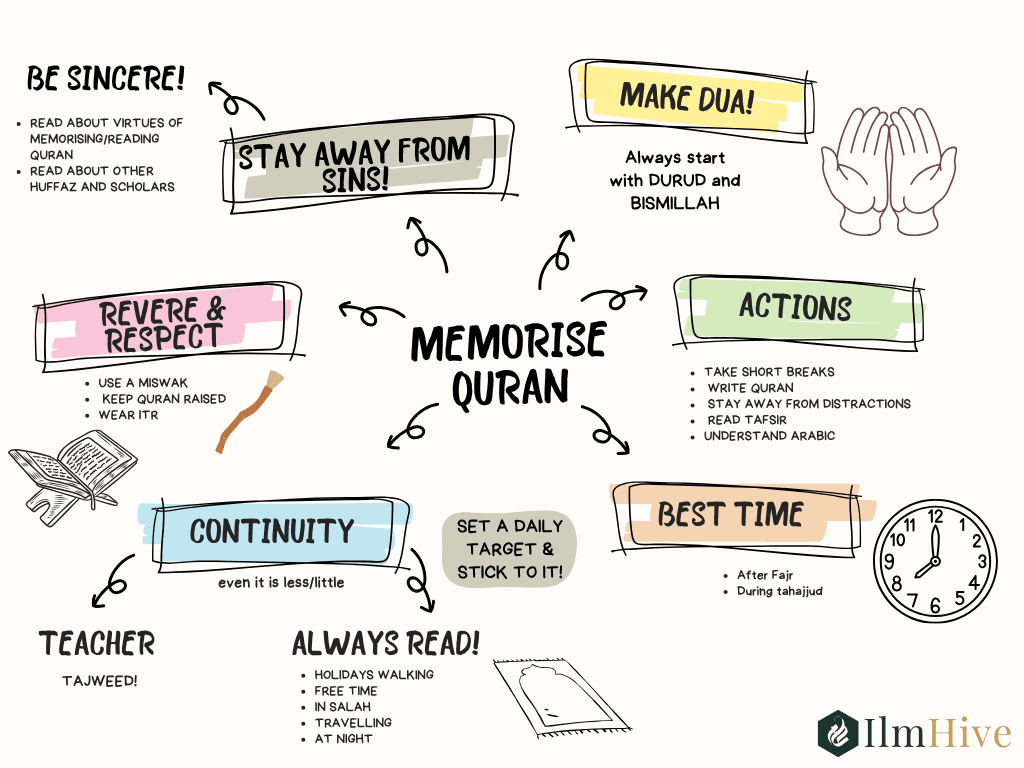
The Qurʾān is the word of Allāh, a guidance for mankind. There are many virtues for those who memorise it: the one who learns, memorises and teaches the Qurʾān is the best of people, and will be rewarded with the highest levels in paradise.
A friend once asked me to share some tips on memorising the Qurʾān. What follows are a few drawn from my own experience and from that of other ḥuffāẓ. Some may seem to make little difference, but small things often turn out to matter most.
Sincerity
Actions are judged according to their intentions. Without sincerity in your work, you will find no barakah in your effort, your struggle will go to waste, and you will earn no reward. The aim in setting out on this journey should be to please your Lord and to attain success in the hereafter; to follow our beloved Prophet ﷺ and his Companions; to pray long into the night while others sleep. Those who are sincere in their work reap the greatest benefit.
Reverence of the Qurʾān
It is important to revere and respect the Qurʾān. The Qurʾān is the word of Allāh, the Most High, and when you recognise its status, memorising it becomes far easier. We remember most readily what we hold significant. The Qurʾān is a guidance for all of mankind and should be respected at all times. Handle it with love and care, do not place it in unclean places or beneath any other book, and ensure that you yourself are clean, both physically and spiritually, for this is among the rights of the Qurʾān.
Stay Away from Sins
One reason that many find memorising the Qurʾān difficult is sin. Sins weaken the memory. Make istighfār and tawbah a constant practice, and be wary of your conduct. It is unbecoming for one who seeks to carry the Qurʾān to act against its teachings: the tongue that recites the glorious Qurʾān ought not to lie or backbite. There are many reciters of the Qurʾān whom the Qurʾān itself curses, because their actions stand against the words they recite. Aim instead to be like the Prophet ﷺ, whose character was the Qurʾān, a living example of it.
Importance of Having a Teacher
A teacher is essential. A teacher keeps you on track, guides you through your struggles, and offers timely advice. A teacher will catch the mistakes you do not notice yourself, often the mistakes that are hardest to spot. Make a deliberate effort to attend lessons regularly, without missing a class, even if you have memorised only a single āyah.
Continuity
The best actions are those that are small but continuous. Read and revise every day without fail. Set yourself a target that is small and manageable, and stick to it ardently; continuity is the key. Once reading and memorising the Qurʾān has become a habit, you will find that it gets easier to memorise more. It is often said that the more you memorise, the easier further memorisation becomes. Stick to your daily target of reading and memorising; if you happen to miss a day, be remorseful. This is a difficult journey, one that shayṭān does not want you to traverse, so resolve firmly that the next day you will meet your target and, if possible, make up for what you missed. Do not be disheartened if you stumble at the first hurdle.
Get Inspired
Talk to others who have completed their ḥifẓ. Read the stories of the great luminaries and let them move you. I would recommend The Value of Time by Shaykh ʿAbd al-Fattāḥ Abū Ghuddah, which gives a remarkable insight into the lives of earlier scholars and the importance they attached to time. Its lessons apply equally to the student of knowledge and to the one seeking to memorise the Qurʾān.
Be Always Reading
Be always reading. Whether you are walking, travelling or taking a short break, no hour of the day should pass without some recitation. Make the Qurʾān your companion and learn to love it. Constant recitation will increase your īmān and create a desire and love for the word of Allāh. Know that you are rewarded for every letter you recite, so seek always to increase your recitation where you can, and never be satisfied.
Importance of Good Tajwīd
It is essential to memorise the Qurʾān with correct tajwīd. Many people start memorising with poor tajwīd and later struggle to re-memorise it correctly. With correct tajwīd, the recitation is also more beautiful. When you recite, the angels gather to listen, so recite aloud and with proper tajwīd. I would recommend listening to Maḥmūd Khalīl al-Ḥuṣarī or ʿAlī al-Ḥudhayfī. Their pace is slow, but if you listen carefully you can hear how each word and letter is to be pronounced.
Importance of Using the Same Qurʾān
Use the same Qurʾān throughout your ḥifẓ. When memorising, we paint a picture in our minds and so come to visualise where each verse sits on the page. If asked where Sūrat Yā Sīn is, you would readily say which side of the page it begins on, and whether at the top, middle or bottom of your Qurʾān. The ḥāfiẓ often visualises a verse to recall it, especially when stuck. Familiarise yourself with one print of the Qurʾān and stick to it.
Writing the Qurʾān
Some countries use a written method for memorisation. The teacher dictates the Qurʾān; the students write it on a tablet, repeat it as they write, and then spend time memorising it. Once the verse is memorised they rub it out and recite it back to the teacher. The students therefore have no copy of the Qurʾān of their own, but rely on oral transmission: when stuck, they ask others about the verse and consult a copy of the Qurʾān only as a last resort. The whole process, of writing, memorising, rubbing out and reciting, helps to anchor the memorisation. The technique is used in various countries and recommended by various scholars; paper works just as well.
Using Miswāk
The miswāk is a great and oft-forgotten sunnah. A clean mouth aids memorisation. The Prophet ﷺ said:
Be prepared before you begin. Make wuḍūʾ, use the miswāk, apply ʿiṭr.
Start with Bismillāh and Durūd
The Prophet ﷺ would often begin with bismillāh when undertaking a good action. Begin in the name of Allāh, and you will find barakah in your memorisation.
The Best Times for Memorising
When is the best time to memorise? Many scholars hold that the best time is after fajr, when the mind is fresh. Tahajjud is another excellent time: the mind is again fresh, and there is no better way to strengthen your ḥifẓ than to put it to use in your ṣalāh. If you wish to memorise in the afternoon or evening, treat that session as revision rather than fresh memorisation. The mind is often preoccupied in the evenings with the matters of the day, and it is harder then to embed new recitation in the memory. If possible, take a short power nap, qaylūla, before starting.
Staying Away from Distractions
Memorise in a place free of distraction. Some scholars have noted the benefits of memorising outdoors or beside a river, but this is not necessary; the comfort of one's home will do. Ensure the room is clear of clutter, and, if possible, do your memorisation in a room of empty space. Clutter engages the mind and pulls it away from the verse. Put your phone away as well: it is the easiest way to lose focus. Dedicate that time solely to memorisation, and you will reap the greatest reward.
Take Short Breaks When Tired
It is important to take short breaks when tired. Forcing yourself to memorise when exhausted is unproductive; better to take a short break of ten or fifteen minutes and then resume. A twenty-minute nap often does the trick, but be wary that twenty minutes does not turn into an hour. The break itself should be restful, and should not involve anything that preoccupies the mind. If you spend the break browsing the web, your mind will still be there when you return to the Qurʾān.
Revise in Tahajjud and Ṣalāh
May Allāh grant us the tawfīq to do this regularly. There are many virtues attached to the one who keeps tahajjud. If you can rise to pray tahajjud, then in shāʾ Allāh memorising the Qurʾān becomes that much easier. Reciting the Qurʾān in your tahajjud, you join a select few who have been chosen for ʿibādah at this time. The mind is fresh, and there are few distractions, if any. Reciting the Qurʾān in ṣalāh, moreover, helps to embed the Qurʾān in the mind: you must rely solely on memory, with no recourse to the page if you stumble. The verses you stumble over and recall again and again are precisely those that get etched into the memory.
Learn Arabic and Understand the Meaning
Arabic is a beautiful language. It is the language of the Qurʾān, the language of the people of Jannah. Strive to learn it, for it is the gateway to knowledge. Understanding Arabic often eases memorisation, and beyond that it makes ṣalāh far more beautiful. When you understand what you are reciting, the verses settle more firmly into memory.
Read Tafāsīr
It is sometimes useful to read tafsīr. Tafsīr supplies the background to a sūrah, the circumstances in which an āyah was revealed, and often the implications of the verses. I would recommend a basic tafsīr to begin with, such as Ibn Kathīr in English, or Maʿārif al-Qurʾān for something more detailed. Take care not to let tafsīr pull you away from your memorisation target, however; read it in your spare time.
Make Lots of Duʿāʾ
Duʿāʾ is the root of all worship. Make duʿāʾ to Allāh that He make this easy for you, that you remain sincere in your effort and not work for show. Make duʿāʾ that He strengthens your memory and grants you the ability to memorise the Qurʾān, and that you become one who acts upon what the Qurʾān teaches.
Listen to the Qurʾān
Listen to the Qurʾān whenever you can, especially if you are too tired to recite. Listen in your spare time, on your travels, while at rest. Make a habit of always reciting in your free time, and where reciting is not possible, of listening. This embeds and strengthens what you have memorised, and makes you more fluent in recitation. Pay close attention to the tajwīd; it is also a good idea to listen to an āyah at least once before memorising it, so that you know each letter is being pronounced correctly.
Extra Tips
These are some more uncommon tips and pieces of practical advice gathered from my reading and from speaking with other ḥuffāẓ and ʿulamāʾ.
Keep Qurʾān Raised
This ties in with revering and respecting the Qurʾān. I have read that when asked to recall something, a person tends to look upwards and to the left. There may be a connection: try to keep the Qurʾān raised when you memorise from it. Allāh knows best.
Use a Qurʾān with a Light-Coloured Background
This is a personal observation. I find it best to memorise from a Qurʾān whose page background is not white but creamy. The eye tires less, and memorisation comes more readily. In Mauritania and Morocco, the Qurʾān is often written on stone-like tablets of a natural sandy colour, and memorised from those, which may be one reason their ḥifẓ is so strong.
Nuts, Almonds and Honey
It is related in a ḥadīth:
Honey has many virtues, as the Qurʾān itself notes when it describes honey as a source of healing for humanity. Scholars would mix ground nuts and almonds with honey and milk as an aid to memorisation.
Eat Less
It was the sunnah of our Prophet ﷺ to eat little, never to his fill. There are aḥādīth recording that a month would pass and the fire would not be lit, that is, no cooked food was eaten. One of the standing pieces of advice to students of knowledge is to eat less, since eating tires the body. Eat in balance, not too much, and you will find that you have more energy for your memorisation.