
When Are You Considered a Musāfir?
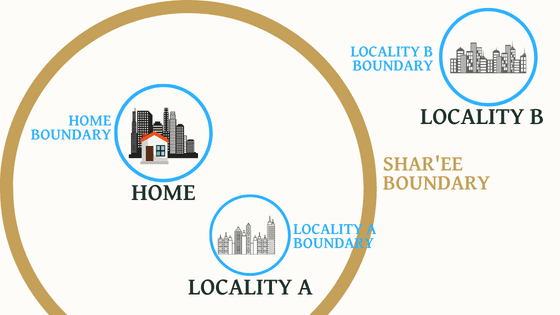 Diagram showing the sharʿī distance defining a musāfir: a home locality (centre), Locality A within the boundary, and Locality B beyond the orange shar'ee-distance circle
Explanation of the diagram
The orange circle marks the sharʿī distance a person must travel to count as a musāfir.
The blue circles show the boundaries of the respective localities. A person who stays the night within these boundaries counts as having stayed in that locality.
Locality A lies inside the sharʿī distance from the home locality, but is itself a separate locality with its own boundary.
Locality B lies outside the sharʿī distance. A person who travels from home to Locality B counts as a musāfir, provided the other conditions are met.
In some cases the boundary of a city may extend beyond the sharʿī limit on some opinions, as in very large cities like Delhi.
When are you considered a musāfir?
The sharʿī distance is fixed by length, not time
A person becomes a musāfir only if he intends to travel a distance reckoned at three days' travel by camel and on foot, the average distance covered in that time. The classical figure is forty-eight or fifty-two miles (on the two opinions), measured from the boundary of the home locality. This is the orange circle in the diagram above.
What matters is the distance, not the time taken: even if the journey is completed in minutes by air, the person still counts as a musāfir provided the other conditions are met.
Scenario
A man travels from his home to Locality B. He becomes a musāfir as soon as he leaves the boundary of his home locality, since Locality B lies beyond the stipulated sharʿī distance. The mode of travel (train, plane or otherwise) makes no difference.
A specific destination must be intended
A person becomes a musāfir only if he intends to travel to a specific destination, and that destination lies beyond the sharʿī distance (al-Jawharah al-Nayyirah).
Scenario
A man wanders from place to place without ever fixing on a destination. He may end up travelling further than the sharʿī distance, even circling the globe, yet he is not a musāfir, because no qualifying destination was intended.
The destination must be habitable
A person becomes a muqīm only if he intends to stay at a place ordinarily fit for residence, such as a city or village. He cannot become muqīm in an uninhabitable place (Badāʾiʿ al-Ṣanāʾiʿ).
Scenario
A man intends to travel to a desert, an island or a boat and to stay there for fifteen nights or more. He does not become a muqīm; he remains a musāfir for the whole stay, since these places are not ordinarily fit for residence.
The sharʿī distance is measured from boundary to boundary
The sharʿī distance is measured from the boundary of the home locality (not the home itself) up to the boundary of the destination locality (not the destination itself). Tools like Google Maps may therefore mislead in borderline cases, since they measure door to door, or door to city centre.
Scenario
A man travels from home to Locality A. From his door, the distance exceeds the sharʿī limit; from the boundary of his home locality, it does not. He is therefore not a musāfir.
The sharʿī distance is not measured as the crow flies
The sharʿī distance is the distance along the route, not the great-circle distance.
Scenario
A man travels from his home locality to Locality C. The straight-line distance between the boundaries is less than the sharʿī limit, but the shortest available route between them exceeds it. He counts as a musāfir, since the minimum distance he must actually travel exceeds the sharʿī limit, even though the crow-flies distance does not.
The sharʿī distance follows the route taken
The sharʿī distance between two places is measured along the route the traveller actually takes.
Scenario
A man travels from home to Locality A, which itself lies within the sharʿī distance, but takes a longer route that exceeds the sharʿī limit. He is a musāfir, because the route he took did exceed the sharʿī distance.
Intention must be paired with the act of travel
Intention alone does not make one a musāfir; it must be paired with actual travel. Likewise, travelling beyond the sharʿī distance without the intention to do so does not make one a musāfir.
Scenario
A man finds himself in Locality B after travelling from his home locality, but without ever intending to go there. He is not a musāfir.
Intention to stay must be under fifteen nights
For the rulings of a musāfir to apply, the man must intend to stay at his destination for fewer than fifteen nights.
Scenario
A man travels from home to Locality B intending to stay fourteen nights or fewer. He is a musāfir.
Scenario
A man travels from home to Locality B intending to stay fifteen nights or more. As soon as he crosses the boundary of Locality B he becomes a muqīm.
What governs is the intention, not the actual stay
So long as a man intends to stay fewer than fifteen nights, he counts as a musāfir, even if he in fact stays longer. The classic precedents are Ibn ʿUmar (raḍ. ʿanhumā), who stayed in Azerbaijan for six months, and Anas (raḍ. ʿanhu), who stayed in Nīsābūr for a year, both performing qaṣr.
Scenario
A man travels to Locality B intending to stay fewer than fifteen nights, but is delayed and ends up staying longer; perhaps he stays for a year, never having intended at any point to stay beyond fifteen nights. He remains a musāfir throughout.
Example
A man travels from London to Bangladesh on an open ticket, intending to stay fewer than fifteen nights, while he waits for a relative's recovery. The doctors say recovery should take a few days; fifteen days pass and they say the same; weeks turn into months. He remains a musāfir throughout.
The open ticket is what matters: a return ticket booked for more than fifteen nights indicates an intention to stay beyond fifteen nights. A return ticket scheduled within fifteen nights leaves him a musāfir.
Where one follows another, the leader's intention counts
If a person is following another, the intention of the one being followed governs (al-Jawharah al-Nayyirah).
So a slave travelling with his master takes the master's intention; a wife travelling with her husband takes the husband's; an army takes the intention of its commander.
Musāfir status begins at the boundary of the home locality
A person becomes a musāfir as soon as he leaves the boundary of his home locality, and becomes a muqīm again as soon as he re-enters it; whether he enters for a need or merely passes through makes no difference.
Scenario
A man intends to travel to Locality B, and from there to Locality A, staying fewer than fifteen nights at each. He is a musāfir throughout, even though Locality A itself lies within the sharʿī distance from home; nor does it matter that the two stays add up to more than fifteen nights, since he never intended to stay at any one place for that long.
Scenario
A man intends to travel to Locality B and stays at Locality A on the way. So long as he stays in Locality A for fewer than fifteen nights, he remains a musāfir, even though Locality A itself lies within the sharʿī distance (Badāʾiʿ al-Ṣanāʾiʿ, p. 499).
Scenario
A man intends to travel to Locality B, and from there to travel back the opposite way to Locality C. If his route takes him through his home locality, he becomes a muqīm the moment he re-enters its boundary, regardless of whether he visits the house or stays the night.