
Kitaab al-Tahara | Wudhu
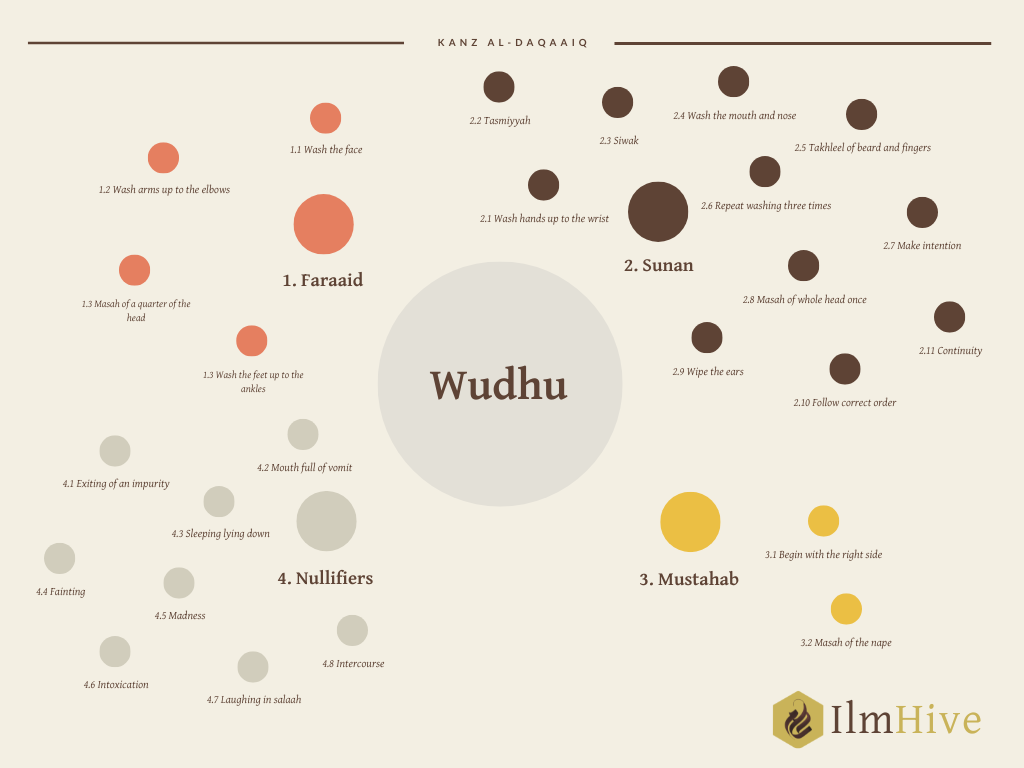
Faraaid of Wudhu
Allah almighty says in the Quran:
Therefore the faraaidh (obligatory actions) of wudhu are four; (1) to wash the face, (2) to wash the arms up to the elbows, (3) to do masah of the head and (4) to wash the feet up to the ankles.
Note:
#1 The face is that which can be seen ie. from the hair on the forehead to the chin, and from one ear to the other ear. Therefore all of this must be washed.
#2 To do masah of at least a quarter of the head is fardh.
Sunan of Wudhu
A sunnah action is that which the Prophet (saw) did so continually, whilst leaving it out occasionally.
The sunan act of wudhu are; (1) to wash hands up to the wrist at the beginning of wudhu, (2) to do tasmiyyah i.e. to begin in the name of Allah, (3) to use the miswak to brush the teeth, (4) to wash the mouth and nose, (5) to do takhleel of the beard and fingers, (6) to repeat the washing of each limb three times, (7) to make intention to do wudhu, (8) to do masah of the whole head once, (9) to wipe the ears, (10) to follow the correct order and (11) to do the wudhu continuously without pause in between.
Note:
#1 When one wakes up, before dipping ones hand into the water container, one should wash their hands three times
#2 Takhleel is to pass ones spread fingers between the hairs of the beard, and between the fingers.
#3 The ears should be wiped with the water from the head and not with new water
#4 There is a difference of opinion as to whether some of these are sunan or mustahabaat. Some ulama mention that the following are mustahab actions; tasmiyyah, siwak, tarteeb, continuity, intention.
Mustahab
A mustahab act is that which was done by the Prophet (saw), but not continually. Mustahab takes the same meaning as mandoob, which can be translated as a recommended action, encouraged by the prophet (saw) even if he did not do it after encouraging it.
1. Begin with the right side
2. Masah of the nape
Nullifiers of Wudhu
Those things which break ones wudhu include; (1) the exiting of an impurity from the body, (2) a mouth full of vomit, (3) sleeping lying down, (4) fainting, (5) madness, (6) intoxication, (7) laughing in salaah and (8) intercourse.
Note:
#1 A mouth full of vomit will break ones wudhu. This is the case if it is bile, coagulated blood, food or water. As for a mouthful of phlegm, or a mixture of saliva and blood in which there is more saliva than blood, then this will not nullify ones wudhu.
#2 The worm which exits from a wound does not break wudhu.
#3 The touching of ones private parts does not break wudhu.
#4 The touching of a woman does not break wudhu.
Related notes
It is said; إنَّ النَّحوَ بابُه حديدٌ، و داخلُه قصبٌ Indeed the door to Nahw is made of iron, whilst …
ReadArticle9 December 2018Extract from Badaai al-Sanaai by Allm. Kasani and Tuhfatul Fuqaha by Allm. Ala al-Deen Samarqandi summarising the key points on the topic of Masah ala al-khuffayn
ReadArticle30 November 2019Extract from Badaai al-Sanaai by Allm. Kasani and Tuhfatul Fuqaha by Allm. Ala al-Deen Samarqandi summarising the key points on the topic of Masah upon bandages.
ReadArticle1 December 2019Explanation of Diagram The orange circle represents the shar’ee distance for which a person must travel in order to be …
ReadArticle24 July 2018